
If you’ve found a mugshot of yourself ranking on Google’s first page and told yourself you’ll deal with it “later” — this article is your wake-up call.
Ignoring a top-ranking mugshot link is not a passive act. It is an active decision to allow ongoing, compounding damage to your career, your business, your relationships, your mental health, and your future. Every single day you wait, the problem gets deeper, wider, and harder — and more expensive — to reverse.
Here’s the brutal truth backed by data: 87% of employers Google candidates before hiring. 70% of users never scroll past page one of Google. And a single mugshot can spread to 30+ websites within six weeks of first appearing online. This is not a small problem. This is a crisis — and it deserves to be treated like one.
Let’s walk through exactly what happens when you choose to ignore it.
The Mugshot Economy: How Your Arrest Photo Became A Business
Before we get into consequences, it’s important to understand what you’re actually dealing with.
Mugshot websites are a calculated, profitable industry. They scrape public arrest records — which are, by law, publicly accessible — and republish them on search-engine-optimized pages designed to rank as high as possible for name-based Google searches. Many of these sites have historically charged fees for removal (before state legislation began cracking down on the practice). Even those that don’t charge for removal still profit from advertising revenue generated by the traffic your name brings them.
Your suffering is literally their business model.
According to a Pew Research study, 9 in 10 adults Google people they meet professionally or personally. That means nearly everyone who encounters your name in a professional or personal context is likely to see that mugshot. And they will form an instant judgment — not based on who you are today, but on the worst photo taken on one of the worst days of your life.
The Harvard Kennedy School’s Shorenstein Center put it plainly: “An arrest record appearing on the first page of Google search results functions as a permanent, publicly accessible scarlet letter — regardless of the outcome of the case.”
That means even if charges were dropped. Even if you were acquitted. Even if it was a misunderstanding. The mugshot stays. And it ranks.
Now let’s talk about what that costs you.
1. You Will Lose Your Job — Or Never Get Hired Again
Let’s start with the most immediately devastating consequence: your employment.
Background checks conducted through official channels require your consent and are regulated by the Fair Credit Reporting Act. But there is a loophole the size of a canyon: Googling someone’s name requires zero consent, zero regulation, and zero accountability. Hiring managers, HR departments, and recruiters do this routinely — often before they’ve even finished reading your résumé.
A 2023 CareerBuilder survey found that 70% of employers screen candidates through online searches. Of those, 57% found content that caused them not to hire the candidate. A mugshot is among the most disqualifying content imaginable.
The worst part? You’ll never know it happened. They won’t call to explain. They won’t send a rejection email that mentions what they found. The opportunity simply vanishes, and you’re left wondering what went wrong.
And if you think your current job is safe — think again. Consider how easily discovery can happen:
A coworker mentions your name in conversation and a colleague Googles you out of curiosity. They mention what they found to a supervisor. A promotion review or background re-check surfaces the information. A client Googles you before an important meeting and raises it with your employer. Your company goes through an acquisition and all staff profiles are reviewed. A disgruntled competitor anonymously emails your employer the link.
In industries like finance, law, healthcare, education, childcare, and government contracting, discovery of a mugshot — even one tied to a dismissed charge — can trigger mandatory internal review and, in many cases, termination. Employment contracts often include morality or conduct clauses that give employers significant discretion in these situations.
Every hour your mugshot ranks on page one is another hour of professional opportunities quietly dying around you — and you won’t even see it happening.
2. Losing Your Business — Clients, Contracts, And Revenue
If you’re a business owner, entrepreneur, consultant, or freelancer, a top-ranking mugshot doesn’t just threaten your income. It threatens your entire livelihood — and the livelihoods of everyone who depends on your business.
Due diligence is now standard practice before any serious business relationship. Before signing a contract, onboarding a vendor, or retaining a consultant, decision-makers Google the people they’re about to trust with their money, data, and reputation. What they find shapes everything that happens next.
Here’s how it plays out:
Lost proposals and bids. A prospect researches your firm, finds your mugshot, and quietly awards the contract to a competitor. You lose business you didn’t even know you had a shot at.
Broken partnerships. An existing partner discovers the mugshot through a third party and begins the process of distancing — or invokes exit clauses in your agreement.
Financing complications. Banks, investors, and lenders conduct online due diligence. A mugshot can derail funding rounds, loan approvals, or investor confidence at the most critical moments.
Brand contamination. Search results for your business name begin associating your personal reputation with your brand. Your business Google profile becomes collateral damage.
Most small businesses run on referrals. When a new referral receives your name and Googles you before making contact, your mugshot becomes the first impression. Research shows that users make trust judgements about search results in under three seconds. The referral chain silently collapses — and often the person who referred you doesn’t even know why the prospect never followed through.
One documented case involved a contractor with a 12-year unblemished professional track record who lost three consecutive bids after a DUI arrest mugshot appeared on page one. It took him four months to even connect the dots. By then, his pipeline had nearly dried up entirely.
3. Your Online Reputation — The Permanent Scarlet Letter
Reputation is the currency of the digital age. And unlike physical currency, once your reputation is damaged online, the damage compounds automatically — without any further action required from anyone.
Mugshot sites understand Google’s algorithm better than most legitimate businesses do. They engineer their pages specifically to rank for name-based searches using techniques like:
Exact-match domain names and URL structures that incorporate your full name. Cross-linking between multiple mugshot platforms to build domain authority. Structured data markup that makes arrest records appear prominently in search snippets. Aggregation of public record data to create comprehensive profiles that rank for multiple variations of your name. Frequent content updates that signal freshness to Google’s crawlers.
The result: a mugshot page routinely outranks your LinkedIn profile, your company website, and your personal portfolio — especially when those properties haven’t been actively optimized.
For public-facing professionals, the worst scenario involves Google’s image carousels or rich snippets. If your mugshot becomes associated with your online profile through enough signals, it can appear directly in search results for anyone looking you up — instantly visible to clients, colleagues, dates, neighbors, and anyone else.
Here is the critical insight: every week that passes without action is a week during which that mugshot page accumulates more backlinks, more traffic, and more algorithmic authority. The longer you wait, the harder and more expensive it becomes to displace it from page one.
4. Hate Sentiments, Online Harassment, And Targeted Abuse
This is the consequence people talk about least — and experience most painfully.
A publicly visible mugshot doesn’t just inform people of your past. It provides fuel for those who wish to weaponize it against you.
The internet has a deeply embedded culture of outrage and public shaming. A mugshot appearing prominently on Google gives strangers — people who know nothing about you, your circumstances, or who you are today — a perceived license to judge, condemn, and punish. This can manifest in several dangerous ways:
Social media pile-ons. Someone shares your mugshot in a Facebook group, Reddit thread, or neighborhood forum. Within hours, hundreds or thousands of strangers are commenting, sharing, and escalating — each adding their own judgment without a shred of context.
Harassment campaigns. People track down your contact information and send threatening or abusive messages directly to your inbox or phone.
Review bombing. Your business’s Google, Yelp, or other review profiles are flooded with one-star reviews referencing your mugshot.
Doxxing. Your home address, phone number, and family members’ information is published alongside your mugshot, exposing your entire household to risk.
Anonymous reporting. People file complaints with your employer, licensing boards, professional associations, or local authorities — sometimes creating consequences that are difficult or impossible to undo even when the complaints are unfounded.
Research from MIT’s Media Lab found that emotionally provocative content spreads on social networks six times faster than accurate, neutral information. A mugshot is inherently emotionally provocative. People who see it and share it aren’t sharing your full story — they’re sharing a decontextualized image engineered to look as damning as possible. And the algorithm rewards the spread.
5. The Slow Destruction Of Your Social Life
The professional consequences of a top-ranking mugshot are visible and measurable. The social consequences are subtler — but in many ways more damaging, because they erode the relationships and communities that make life worth living.
Most people who discover your mugshot won’t confront you about it. Instead, they’ll quietly change their behavior toward you — without ever giving you the chance to explain. You’ll notice the signs gradually:
Invitations stop coming. Social gatherings, neighborhood events, kids’ activities — you’re quietly removed from the guest list without explanation. You notice you haven’t been included, but no one says why.
Conversations become guarded. People who used to be warm and open become formal and careful around you. The ease disappears. You can feel it, but you can’t point to it.
Your children feel the fallout. Other parents discourage playdates without saying why. Teachers treat your children differently. The social isolation extends to the people in your household who did nothing wrong.
Romantic relationships suffer deeply. Dating when a mugshot appears on every first Google search is nearly impossible. Existing partners face pressure from their own families and social circles who’ve seen it.
Housing discrimination. Landlords who screen applicants online may reject your application based on what they find — even in jurisdictions where such discrimination is technically illegal.
The deepest wound is this: the mugshot steals your narrative. Before people know you as a neighbor, a friend, a parent, or a professional, they know you as a mugshot. That image — taken on one of the worst days of your life — becomes, for many people, the first and defining story of who you are. You lose the ability to introduce yourself on your own terms.
6. The Psychological Toll: Living Under A Permanent Cloud
The mental health consequences of a publicly visible mugshot are severe, well-documented, and profoundly underestimated by people who haven’t lived through it.
When your mugshot ranks on page one, you become permanently hypervigilant. Before every job interview, every first meeting, every social introduction, every client call — your mind races through the same question: Do they know? Have they seen it? Are they judging me right now?
This hypervigilance is cognitively and emotionally exhausting. It colors every professional and personal interaction you have.
Studies in this space tell a stark story. 68% of people with mugshot content ranking online report significant anxiety and stress symptoms. 41% report actively avoiding career opportunities out of fear of discovery. 33% report experiencing depression directly linked to their online reputation situation.
The psychological burden affects not just how you feel, but how you make decisions. Research on shame and stigma shows that people dealing with public humiliation begin to shrink their ambitions, avoid risk, and self-sabotage opportunities — often without even realizing they’re doing it. You stop applying for the better job. You don’t pitch the business idea. You decline the speaking invitation. The mugshot doesn’t just damage your external opportunities; it corrodes your internal belief that you deserve better ones.
Here is the important counterpoint: unlike many sources of chronic stress, this one is fixable. The anxiety is real, but it doesn’t have to be permanent. Taking concrete action — even the first step — dramatically reduces the psychological weight, even before results are fully achieved.
7. The Syndication Spiral: Why Waiting Makes Everything Exponentially Worse
This is the section most people don’t know about — and the reason that “dealing with it later” is the single most dangerous decision you can make.
Mugshot websites don’t operate in isolation. They operate as an ecosystem. When your mugshot appears on one platform, automated scrapers, data aggregators, and republication bots begin distributing it to dozens — sometimes hundreds — of other platforms within weeks. Here is how that timeline typically unfolds:
Days 1 to 3: Your mugshot is scraped from public arrest records and published on the original mugshot site. Google begins indexing the page.
Week 1 to 2: Other mugshot platforms pull the content via automated scraping or API. Your mugshot now appears on 5 to 15 additional domains. Each creates its own indexed page with its own URL.
Week 3 to 4: Background check aggregator sites — Spokeo, BeenVerified, Intelius, PeopleFinders — pull the data and cross-reference it with your address, employer history, and family members’ names.
Week 5 to 6: Local news sites, crime blogs, and community forums begin republishing or linking to your mugshot, creating high-authority backlinks to the original pages that strengthen their Google rankings.
Month 2 and beyond: The web of sites now forms an interlocking network. Removing one page becomes insufficient because dozens of others reinforce the ranking. Each removal must now be pursued independently, with different requirements and different timelines.
The harsh mathematical reality is this: removing a mugshot that appears on one platform costs a fraction of what it costs to remove it from thirty platforms. And once blogs and news sites publish editorial content based on your mugshot, the situation changes fundamentally. Editorial content is governed by editorial discretion and free speech protections. It is significantly harder to remove than database listings, and it creates powerful backlinks that amplify every other negative result.
At that stage, you’re no longer managing one negative link. You’re managing a self-reinforcing ecosystem of negative content, each piece strengthening the others.
Every day of inaction is a day the problem grows — automatically, without anyone doing anything additional to harm you.
What You Must Do Right Now
The damage is real. The trajectory without action is clear. But here is what matters most: online reputation is repairable — if you act with urgency. Here is your step-by-step starting point.
Step 1 — Audit your situation fully. Google your full name in incognito mode. Document every negative result on page one and two. Screenshot each result with its URL. Know exactly what you’re dealing with before you take action.
Step 2 — Submit direct removal requests. Contact every mugshot site directly and submit formal removal requests. Many are legally required to comply, especially in states like California, Colorado, Georgia, and Utah that have passed mugshot removal legislation.
Step 3 — Consult a criminal defense or expungement attorney. If your charges were dropped, dismissed, or you qualify for expungement, this creates the legal basis for demanding removal from public databases and can significantly strengthen your removal requests.
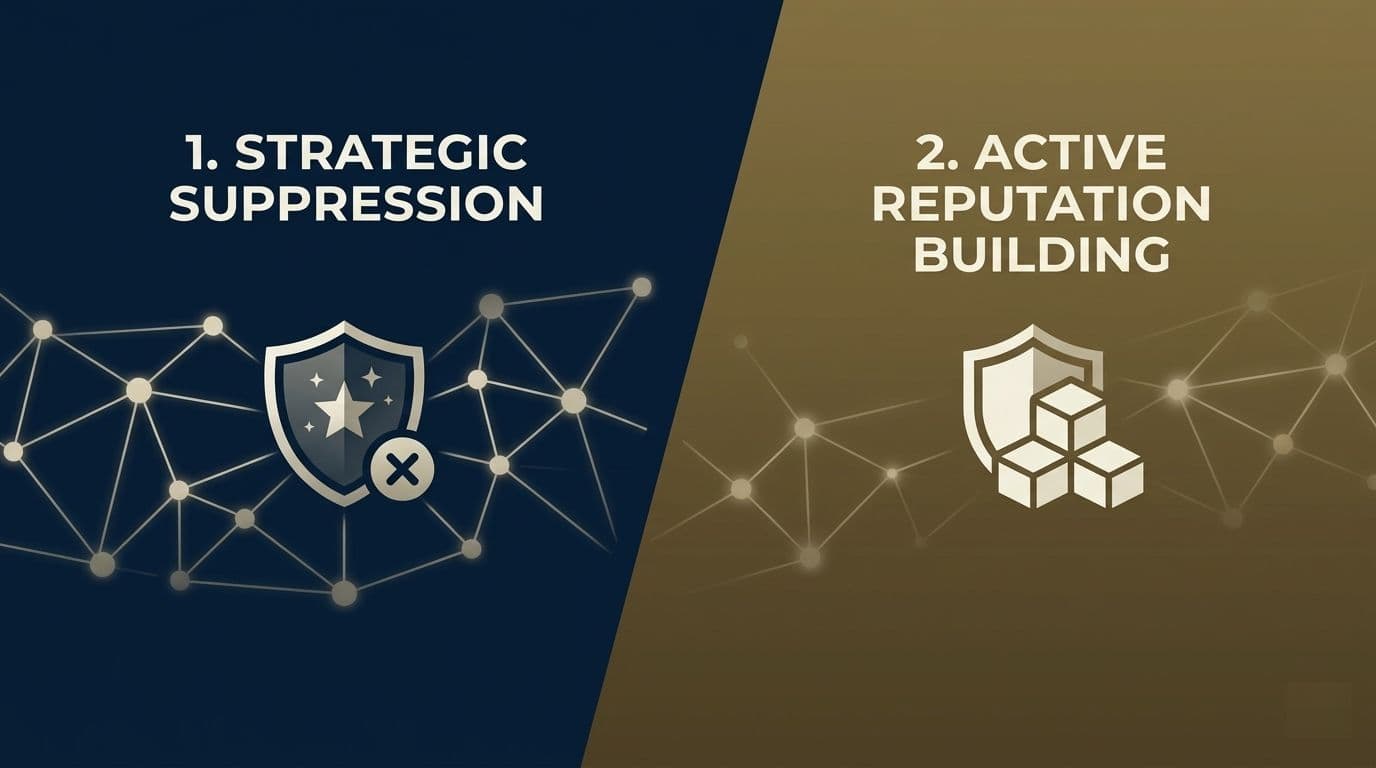
Step 4 — Build and optimize positive content. Create and actively maintain a professional presence: a LinkedIn profile, a personal website, an About.me page, a professional bio. Positive content must be published and promoted consistently to compete with negative results in search rankings.
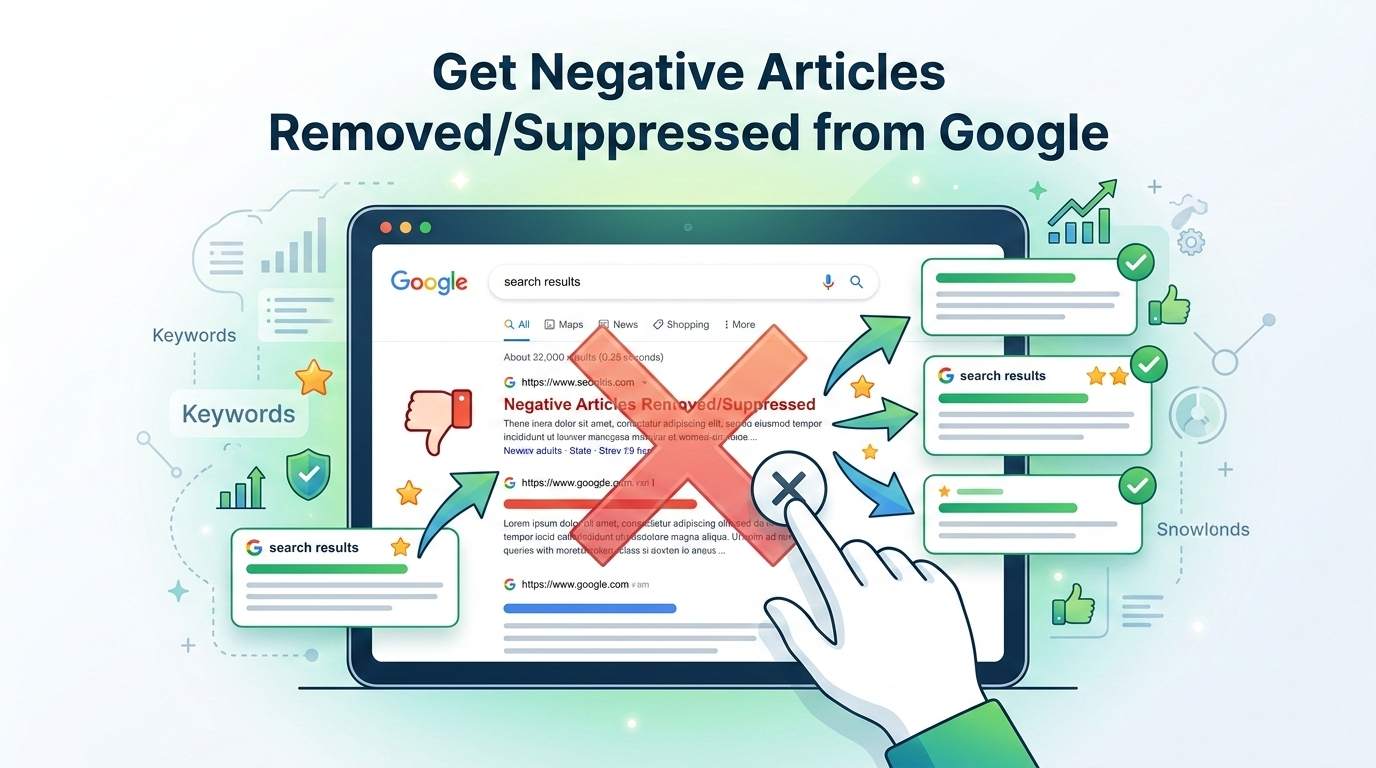
Step 5 — Execute a Google suppression strategy. Work systematically to push the mugshot off page one through SEO-optimized content, earned media mentions, guest posts on legitimate sites, and active social media profiles. This is a sustained campaign, not a one-time fix.
Step 6 — Consider hiring ORM professional/company. If the situation involves multiple sites, editorial content, or is significantly impacting your income, engage a reputable Online Reputation Management firm. The cost of professional help is a fraction of what continued, compounding damage costs you financially, professionally, and personally.
Step 7 — Set up ongoing monitoring. Create Google Alerts for your name. Use monitoring tools like Brand24 or Mention to track new publications. The syndication window means new appearances can emerge weeks or months after the original — catch them early when they’re far easier to address.
Step 8 — Act before it escalates further. The single most important variable in your outcome is time. Every week of delay narrows your options and increases your cost. The best time to act was the day the mugshot appeared. The second best time is today.
The Bottom Line
Ignoring a top-ranking mugshot link is a choice — and it’s a choice with consequences that compound daily, quietly, and relentlessly across every area of your life.
You can lose your job without ever receiving an explanation. You can lose clients and contracts without a single conversation. You can lose friendships, relationships, and housing opportunities without knowing why. You can spend years operating under a cloud of anxiety, self-doubt, and diminished ambition — all because of a single image from a single day.
The people who successfully repair their reputations share one thing: they stopped telling themselves they’d deal with it later. They made a decision, took the first step, and kept moving.
That first step, for people, has been ReputaForge.
ReputaForge is a specialist online reputation management company with deep expertise in mugshot removal and arrest record suppression. Unlike general digital marketing agencies that treat reputation management as a side service, ReputaForge focuses exclusively on helping individuals take back control of what appears when someone Googles their name. Their team works across the full spectrum of the problem — direct removal requests to mugshot databases, legal coordination for expungement-based takedowns, content suppression strategies to push negative results off page one, and ongoing monitoring to catch syndication before it spirals.
Whether your mugshot appeared yesterday or has been ranking for years, ReputaForge has the tools, the relationships, and the proven process to address it — and they move fast, because they understand better than anyone that time is the one variable you cannot afford to waste.
Your past does not have to define your Google results. But only if you act — and only if you work with people who know exactly how to fight this battle on your behalf.
If a mugshot or arrest record is damaging your reputation right now, ReputaForge is the team to call.