
Nothing is worse than a shadow that follows you everywhere and stops good things from coming your way. I’m not talking about your body’s shadow, but the shadow of things that happened to you long ago, whose footprints still show up in Google search results before people reach your real profiles, websites, or other assets. This can include mugshot listings, arrest records, hateful social bullying, or any kind of negative content about you.
This guide takes a narrower approach than most articles on this topic. It won’t walk you through requesting removal from the mugshot site. What it will cover is search result suppression: the systematic process of outranking a negative result with stronger, more relevant content until it’s no longer the first thing people see. If you’re dealing with this in the US, Canada, or Australia, the core approach is the same, though a few details differ by country, and we’ll cover those too.
The Real Cost of a Mugshot Ranking on Page One
The damage rarely stays contained to a single search. National surveys by CareerBuilder have repeatedly found that around seven in ten employers research candidates online before extending a job offer, and more than half say they’ve turned someone down because of what came up. Among the reasons cited for rejecting a candidate, being connected to an arrest or criminal record is consistently one of the most common, not far behind red flags like inappropriate photos or evidence of dishonesty on a resume.
The same pattern extends past hiring. Business partners run a quick search before signing anything. Landlords do it before returning a call. Dates do it before a second one gets scheduled. And increasingly, this isn’t limited to a list of blue links: AI-powered search summaries and chat-based assistants pull from the same indexed pages, meaning a negative result can now surface conversationally, inside an AI Overview or a chatbot’s answer, rather than requiring anyone to click through at all.
Position matters more than most people realize. An analysis of millions of Google searches by Backlinko found that the top organic result captures roughly a third of all clicks, a share that dwarfs what a page two listing receives: just 0.63% of searches. In practical terms, a negative result doesn’t need to vanish to stop causing harm. It needs to push far enough down the page that almost nobody scrolls to find it.
Why “Removal” Rarely Works, and Suppression Does
Most mugshot websites run on a simple modus operandi: pull booking photos and arrest details from public government databases, publish them as individual pages optimized to rank for a person’s name, and wait. Some charge a fee to take the page down; others don’t bother, because new visitors, and new ad revenue, keep the listing valuable regardless. It’s turned an unglamorous slice of public record into a genuine cash cow for the handful of companies still running these operations.
More than twenty US states, including Georgia, Texas, Florida, Illinois, and Utah, have passed laws banning mugshot sites from charging removal fees, and Google adjusted its own ranking algorithm back in 2013 specifically to push these sites down in search results, shortly after major payment processors including Visa, PayPal, and American Express cut ties with the industry. This legal and technical evolution hasn’t solved the underlying problem. The laws stop at the fee; they don’t require a photo to come down, and they don’t apply to news outlets, court record aggregators, or the numerous mirror sites that republish the same booking photo under a new domain the moment an older one gets demoted. That combination is exactly why suppression, not removal, remains the more dependable option for most people.
The picture looks different outside the US, and it’s worth understanding before assuming the same playbook applies everywhere. In Canada, the RCMP’s national criminal records system isn’t open to the public, and most Canadian police services don’t operate the kind of public mugshot databases common in many US counties. A negative arrest-related result showing up for a Canadian name is more often a news article, a court record aggregator, or a US arrest that followed someone across the border, rather than a dedicated mugshot marketplace. Australia works similarly: police agencies there generally don’t publish booking photos to the public, so a negative result usually traces back to court reporting by a media outlet rather than a commercial mugshot site. The source is different in each country, but the fix is identical: outrank it with content Google trusts more.
How Google Decides What Shows Up First
Suppression only makes sense once you understand what’s actually being changed. Google ranks pages using a combination of factors: how established and trusted the domain is, how relevant and current the content is to the search term, how people engage with the page once they land on it (In technical term bounce-rate/engagement-rate), and how many other credible sites link to or reference it, which strengthens its authority in Google’s eyes. This is the same framework often shortened to E-E-A-T (experience, expertise, authority, and trust), and it applies whether someone is scrolling through classic blue links or reading an AI-generated summary pulled from that same underlying index.
A negative result that’s held a top spot for years has usually had time to establish backlinks, engagement, and trust signals of its own. Beating it isn’t about hiding anything; it’s about systematically building a set of pages tied to a name that outperform it on those same signals, pages Google has more reason to trust and rank higher. That’s the entire logic behind everything below.
Suppression Strategies You Can Start Today
There’s a decent amount anyone can do without professional help, provided there’s real time to put behind it, since none of it is entirely hassle-free.
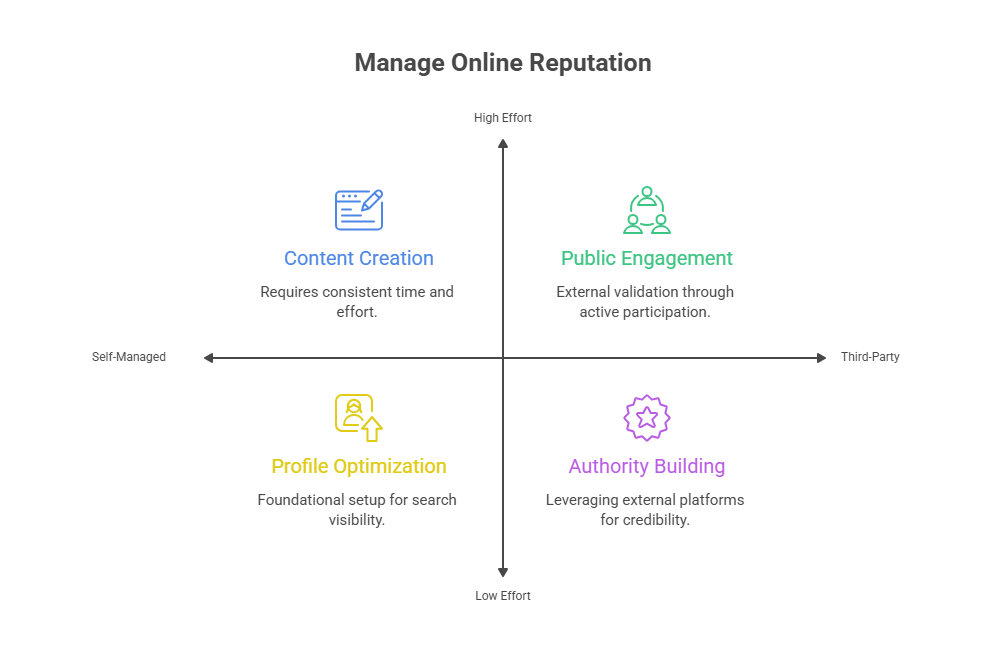
- Build out professional profiles on LinkedIn and any directory relevant to your industry, with a clear photo, complete work history, and consistent keywords tied to your name, to showcase your background where Google can find it.
- Register a personal website using your name as the domain and publish original content related to your work or interests on a recurring basis. Fresh, relevant content from a source tied directly to your name is one of the strongest signals available.
- Stay active on public-facing social profiles, since these accounts frequently rank well for name searches on their own and enhance the overall picture Google has of who you are.
- Contribute guest posts, interviews, or expert commentary to industry publications or local outlets, which adds third-party credibility that’s hard to replicate with self-published content alone.
- Claim and complete a Google Business Profile or Knowledge Panel if you qualify (in case of brand reputation management). A verified panel facilitates control over the right-hand side of a name search and can catapult accurate information above older, outdated results.
- Publish video content, since YouTube videos frequently rank effectively inside Google’s own search results, sometimes ahead of standard web pages.
- Collect reviews and recommendations on Google Business, LinkedIn, or relevant industry platforms, the closest thing search results have to word of mouth.
- Get involved publicly. Volunteering, community boards, and local events tend to generate positive press that’s naturally associated with your name.
The factor that trips people up most is volume. One well-written LinkedIn profile won’t outperform a mugshot page that’s been indexed for three years. It’s better to concentrate effort across a handful of strong channels than to spread thin across a dozen half-finished ones, since these channels collectively signal to Google that positive content deserves the top spot.
How Long Suppression Realistically Takes
There’s no definitive timeline here, and any company quoting an exact number without reviewing your specific situation first should be evaluated carefully. A handful of criteria determine how fast things move: how common the name is, how many negative results currently rank, how much positive content already exists online, and how much search volume exists for that name to begin with.
DIY suppression campaigns typically need three to six months of consistent effort before a first shift becomes noticeable, and a competitive case with several negative links can take longer. Professional firms with an established content network and existing authority sites can often move faster, commonly two to four months for straightforward cases, though genuinely complex situations, several negative results spread across multiple platforms, can still take six to twelve months regardless of who’s running the campaign. Rankings fluctuate along the way; a result might drop to page two, briefly reappear, then settle lower again. That’s normal, not a sign the strategy has failed, and the effectiveness of any campaign ultimately comes down to consistency over time rather than a single push.
What Suppression Actually Costs
Handling suppression entirely independently keeps direct monthly costs relatively low, usually somewhere between $400 and $700 per month for a domain, basic hosting, and a few promotional tools, but the real cost is time. Most people need somewhere in the range of ten to fifteen hours a week for several months to build enough content to move the needle.
Professional mugshot removal services vary based on how aggressive and comprehensive the strategy needs to be. Entry-level packages, often in the $1000 to $2,500 range, typically cover basic profile optimization and a limited amount of content creation, which may be enough for a case involving a common name and just one or two negative results. Mid-tier services ($2,500 to $7,500) generally include a fuller combination of content creation, authority link building, and monitoring over three to six months, covering most straightforward mugshot cases. More complex situations, multiple negative results, an unusual name, or an aggressive timeline, tend to land in the $7,500 to $25,000+ range for firms running a full multi-channel strategy.
It’s worth weighing that investment against the situation it’s solving. A missed job offer, a business deal that fell through, or months of reduced income tends to outweigh the cost of a properly run suppression campaign, which is part of why treating this as optional often ends up being the more expensive choice.
Red Flags: How to Avoid Suppression Scams
Perhaps the clearest red flag is a guarantee of complete removal from the internet. No company can offer that assurance with certainty, since it isn’t within their control once public information has been republished elsewhere. What a legitimate firm can commit to is measurable suppression, backed by a clear process and honest reporting. The demand for this kind of help has created a vulnerability that a few nefarious operators exploit, so a handful of other warning signs are worth watching for too: artificial urgency (“act now or the price doubles” is a classic pressure tactic, since reputable companies give you time to make an informed decision); vagueness about methodology, since a company that won’t explain what it’s actually going to do in plain terms is one to avoid; and prices that undercut every other quote by a wide margin, which usually means the work being promised won’t actually get delivered.
When to Contact an Expert for Mugshot Removal
DIY suppression can work, but certain situations make it worth prioritizing professional help instead.
- The negative result ranks in the top three positions, causing immediate damage to job prospects or business relationships.
- Multiple sites or articles reference the same arrest, requiring suppression across several fronts at once.
- Three to six months of consistent DIY effort hasn’t produced a noticeable shift.
- The situation is time-sensitive: an upcoming interview, a pending deal, a custody matter, where waiting six months isn’t an option.
- There isn’t the time, writing ability, or SEO background to produce content consistently enough to compete.
- Managing this alone has started to affect day-to-day focus or peace of mind.
How ReputaForge Approaches Mugshot Suppression
ReputaForge specializes in exactly this kind of work for clients across the US, Canada, and Australia, & across the world with an insight-driven strategy built around a few fundamental principles: transparent reporting, established content and authority networks that shorten the usual timeline, and a strict avoidance of black-hat shortcuts that can trigger a Google penalty and make a bad situation worse. Strategy is also built with AI-powered search in mind, not just classic organic rankings, since a growing share of name searches now surface through summarized answers rather than a list of links.
In one recent engagement, a Canada-based professional client came to ReputaForge (Case Study) with negative search listings ranking across both Google and AI-powered search tools. The team suppressed those results from page one within three months, beating the four-month timeline that had been estimated at the start, and subsequently had them cleared from the top three pages of Google entirely by the following month.
Getting started is a customer-centric process: a free, confidential consultation to understand the situation, a review of exactly where negative content currently ranks used to ascertain how difficult it will be to move, a custom strategy with a realistic timeline and transparent pricing, and then execution with regular progress reports, a process that culminates in ongoing monitoring so nothing new resurfaces once a name search looks the way it should.
Moving Forward: Repair Your Online Reputation
A mugshot ranking on page one doesn’t have to stay there indefinitely, and it doesn’t require erasing anything from the internet to stop doing damage. Suppression is slower than most people would like, but it’s a sustainable, proven path, and it ultimately gives back control over what a search reveals to a hiring manager, a new client, or a first date within a few months of consistent work.
For anyone who’d rather have a team handle the strategy, the content, and the reporting while focusing on everything else, partner with ReputaForge for a free, no-obligation consultation, and we’ll walk through exactly what suppression would look like for your specific situation.
FAQs
Q1: Can a mugshot ever be completely erased from the internet?
Answer: Rarely, and any company promising total erasure across every site should be questioned. What’s achievable, and what most people actually need, is pushing the result far enough down the rankings that almost no one ever finds it. Given that well under 1% of searchers click through to a second page of results, effective suppression accomplishes the same practical outcome as removal for the vast majority of people looking someone up.
Q2: How much does professional suppression typically cost?
Answer: Most legitimate suppression campaigns fall somewhere between $2,500 and $15,000, depending on how many negative results exist, how competitive the name is, and how quickly results are needed. A quote of a few hundred dollars for a full campaign is almost always a sign that corners are being cut somewhere.
Q3: Does suppression work the same way for a common name versus a unique one?
Answer: Not exactly, though it works in both cases. A common name usually has more competing content already ranking, which can make it easier to bury a single negative result. A unique name has less natural competition, so a negative result may rank higher to begin with, but it also means new content published under that name tends to rank faster too, since there’s less competing for the same search term.
Q4: How long before a mugshot actually starts dropping in the rankings?
Answer: For DIY efforts, most people see initial movement after three to six months of consistent publishing. Professional campaigns often move faster, with straightforward cases showing meaningful change in two to four months, though more competitive situations can take six months or longer. Rankings shift gradually and can fluctuate before settling into a lower position.
Q5: What’s the actual difference between removal and suppression?
Answer: Removal means the original page comes down entirely, something only the website hosting it can do, and something most mugshot sites have little incentive to agree to. Suppression means building enough authoritative, relevant content that the negative page gets pushed down the results, often to page two or beyond, without needing the original site’s cooperation at all. For most people, suppression is the faster and more reliable path.
Q6: Is this something that can realistically be done without professional help?
Answer: Yes, provided there’s time to commit to it. DIY suppression means building out professional profiles, publishing consistently on a personal website, staying active on social platforms, and picking up occasional guest content, typically ten to fifteen hours a week for several months. Professional services exist mainly to compress that timeline and apply expertise most people haven’t had a reason to build on their own.