
Florida already gives you one of the strongest tools against commercial mugshot websites, and it costs nothing. Under Section 901.43 of the Florida Statutes[1], a business that publishes booking photos cannot charge you to take yours down, and once it receives your written request, it has ten calendar days to comply. Plenty of people pay hundreds or even thousands of dollars without anyone mentioning this.
So why does a whole market of paid removal and suppression companies exist? Because the statute solves only part of the problem. It reaches certain publishers. It does not reach a sheriff’s office website, a local news story, a forum thread, or an operator sitting outside U.S. jurisdiction, and it does nothing about what Google has already indexed. That gap is where suppression work lives: building credible, relevant pages that climb above the arrest-related results until those results sit somewhere hardly anyone looks.
This guide compares ten companies that work on Florida mugshot problems, using the prices and claims they publish on their own websites and on Clutch.
Why Mugshot Suppression is a Big Challenge in Florida
Florida’s open-records tradition means a booking photo begins life as a public document, and commercial publishers have long used it as raw material. When lawmakers were first debating the issue, NBC Miami reported that one large site charged $399 to remove a single arrest and $1,799 for five[2]. Charging for removal was a cash cow, and it explains why so many of these sites existed. Florida’s ban on that practice weakened the business model, but it did not erase the pages already published.
The next problem is multiplication. One booking can be copied by several aggregators, each a separate page with its own owner, its own server and its own response time. Getting one taken down does not touch the others. Even after a page disappears, an indexed or cached version can linger until Google recrawls it, so a person can believe the job is finished while their name still returns the old result.
Google itself helped years ago when it adjusted its ranking to demote sites that profit from mugshots without adding original content, according to law-firm commentary from that period. That moved many pure mugshot sites off page one. Arrest information still turns up elsewhere, though: in news articles, court-record aggregators and forum posts that Google treats as ordinary content. Those results appear outside the mugshot statute, which is why a removal letter alone rarely ends the story.
Why Florida Is Different From Other States
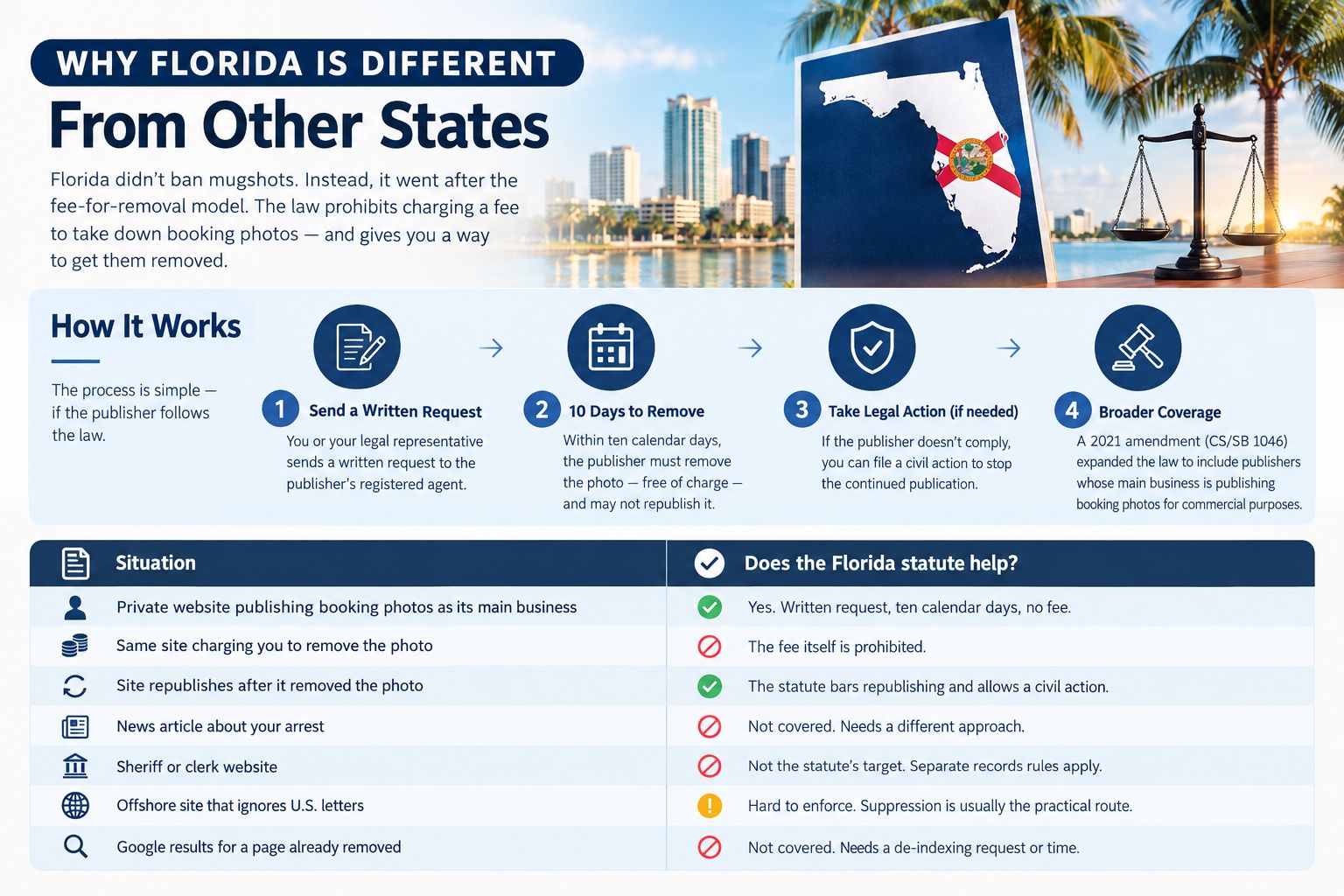
Florida’s approach has a particular shape. The legislature chose to go after the fee-for-removal model rather than ban the publication of booking photos. A 2021 House analysis put it plainly: Florida law does not specifically prohibit mugshot companies from posting booking photographs, but it prohibits charging a fee to take them down.
Here is how the mechanism works today. The person in the photo, or their legal representative, sends a written request to the publisher’s registered agent. Within ten calendar days the publisher must remove the photo without charge and may not republish it. If it fails to do so, the person can file a civil action to stop the continued publication. A 2021 amendment (CS/SB 1046) widened the law to cover publishers whose primary business is publishing booking photographs for commercial purposes[3], and the legislature’s summary describes continued publication after a request as an unfair or deceptive trade practice.
Other states moved earlier. NBC Miami noted at the time that Florida was trailing several of them, and that after Georgia’s law took effect, one major operator stopped removing photos altogether instead of complying. The detail worth remembering is that Florida’s remedy depends on you, or someone acting for you, enforcing it one publisher at a time.
| Situation | Does the Florida statute help? |
| Private website publishing booking photos as its main business | Yes. Written request, ten calendar days, no fee |
| Same site charging you to remove the photo | The fee itself is prohibited |
| Site republishes after it removed the photo | The statute bars republishing and allows a civil action |
| News article about your arrest | Not covered. Needs a different approach |
| Sheriff or clerk website | Not the statute’s target. Separate records rules apply |
| Offshore site that ignores U.S. letters | Hard to enforce. Suppression is usually the practical route |
| Google results for a page already removed | Not covered. Needs a de-indexing request or time |
The other half of the Florida picture is sealing and expunction. A person generally gets one court-ordered sealing or expunction in a lifetime under FDLE’s process, and a Certificate of Eligibility from FDLE is the first step. That certificate does not seal anything by itself, a court still has to grant the petition, and certain convictions disqualify an applicant. A Broward State Attorney’s Office guide adds that the certificate stays valid for twelve months, so applicants who stall have to restart. Because the one-time limit is real, people sometimes spend it on a minor case and later regret it, which is worth discussing with a Florida criminal defense attorney before you file.
Why Acting Early Matters
Search behavior makes the priority clear. In Backlinko’s analysis of four million Google results, the first organic result earned 27.6% of clicks, while only 0.63% of searchers clicked anything on the second page[4]. The takeaway for mugshot work is practical: the target is not “lower on page one.” It is page two and beyond, where almost no one goes.
Timing matters for a second reason. Suppression is slow and unglamorous work, and the result you want is a stable one. Companies describe timelines differently: Reputation Pros says a full campaign usually takes six to twelve months, Reputation Resolutions says suppression often shows measurable progress in sixty to ninety days, and a Canada-based professional services client of ReputaForge saw negative links leave page one in three months against a four-month estimate. Those are different companies and different cases, so treat them as ranges, not promises.
Finally, a mugshot does not tell the viewer how the case ended. Dismissed, pending, convicted and sealed cases can all produce the same photo and the same headline-style search result. Someone checking you for a job, a rental, a professional license or a business deal sees only the image. That is the practical reason to prioritize the issue before an application or an interview, not after.
How We Compared These Companies
We evaluated each company against the same criteria, and we treated missing information as information.
Pricing and how it is structured. A flat fee, a monthly retainer and a pay-per-result model are not directly comparable, so we say which one each company uses and show a twelve-month cost comparison later. Where a company does not publish prices, we say so rather than guess.
Process. We looked for a clear explanation of what happens in the first thirty days, whether the company starts with a free audit, and whether it separates removal from suppression.
Expertise. Law firms and reputation agencies solve different parts of this problem. Attorneys can send enforceable demands and handle sealing or expunction. Agencies build the content that moves search results. We noted which category each company sits in.
Clutch rating and review volume. Clutch verifies reviews, which gives it more weight than a testimonial on a company’s own site. A 5.0 rating from one review and a 5.0 rating from twenty-six reviews are very different signals, so we show the count wherever we could verify it.
Word of mouth and third-party validation. Awards, BBB standing, press mentions and independent reviews all count, though some of those badges are self-reported or paid placements, and we flag that when we see it.
Honesty about limits. The most reliable companies say that nobody can guarantee removal. We gave credit to those that put it in writing.
Our sources were each company’s website, its Clutch profile where one exists, and primary sources such as the Florida Statutes and FDLE. Company figures like “success rate” and “clients served” are the companies’ own claims and we have not audited them.
Removal, Suppression, or Both? A Quick Decision Path
Before you pay anyone, it helps to sort the problem. Start with what is actually showing up. If the result is a commercial mugshot website, the statutory request is free and fast, and a paid service is mostly buying convenience and follow-through. If the result is a news article, a court-record aggregator or a forum post, the statute does not apply, and you are looking at a publisher request, a correction or suppression. If your case ended in dismissal or you qualify for sealing, a lawyer can often strengthen every later request, because a court order is something publishers and search engines take seriously.
In practice, most people end up needing a combination. Take down what the statute reaches, pursue sealing where you qualify, and use suppression for whatever remains. DeleteMugshot says this itself on its own site, noting that you can send the statutory demand yourself and that its value is in execution: finding every copy, tracking each deadline and chasing sites that ignore the first letter.
The List: 10 Companies That Push Down or Remove Mugshots in Florida
#1. ReputaForge
Website: https://www.reputaforge.com
Pricing: $400/month
Best for: People who need ongoing suppression, plus branding and web assets, at a monthly price below most agency retainers.
About the company: ReputaForge is an award-winning online reputation management company launched in 2020. It works mostly with clients in the USA, Canada and Australia, and it also takes on individuals and businesses elsewhere. Its stated approach is a simple, transparent process in which clients always know what is being done and why, and it does not disclose a client’s identity without approval. In 2026 it won the Online Reputation Management Excellence Award at the 9th Great Companies SME Business Awards[5].
Key services: Online reputation management, mugshot removal and suppression, reputation crisis management, branding, digital marketing and web development.
Rating at Clutch: 5.0 out of 5
Worth knowing: ReputaForge is the smallest but results-oriented company in this list. Its advantage is price and a team that handles the content-building side of suppression in-house.
#2. DeleteMugshot
Website: https://deletemugshot.com/
Pricing: $1,500 flat fee (the company’s site describes one price per booking, with a year of monitoring included, rather than a monthly charge)
Best for: One booking mugshot on commercial mugshot websites in Florida.
About the company: A Miami service business that says it has served clients since 2017. It sends statutory removal demands under Section 901.43, follows up on sites that ignore them, and pursues Google de-indexing as pages come down. It begins with a free audit that shows where your photo is posted.
Key services: Statutory takedown demands, enforcement against non-compliant sites, Google de-indexing, twelve months of monitoring, and a promise to remove the same booking mugshot again at no new charge if it resurfaces. News articles are handled by consultation because they fall outside the mugshot statute.
Clutch rating: No Clutch profile.
Worth knowing: It is a removal service, not a law firm, and it states that a takedown does not seal or expunge a record. It also says openly that you can do the same thing yourself, which is the kind of candor that earns trust. It focuses on removal of the photo itself, so it is not a substitute for broader suppression.
#3. ContentRemoval.com
Website: https://www.contentremoval.com/
Pricing: Not published. Each case is quoted in writing per link after a free exposure scan.
Best for: People with several types of damaging content, not only a mugshot.
About the company: A Miami-based content removal firm operating since 2017 under founder Frankie Lee. Its stated approach is to go after removal at the source first and use suppression only when removal is not realistic, and it grades each item as removable, de-indexable, suppressible or better left alone.
Key services: Mugshot and arrest-record removal, search-result removal, defamation takedowns, review removal, data-broker removal, plus monitoring plans.
Clutch rating: No Clutch profile
Worth knowing: The company advertises large totals, including more than sixteen million links removed since 2017, which are self-reported and span all content types. Pricing is per link, so the final cost depends on how many pages carry your photo.
#4. Rier Jordan
Website: https://www.rierjordanlaw.com/
Pricing: Not published. Free consultation offered.
Best for: People whose case ended in dismissal, acquittal, diversion or an eligible sealing, and who want a lawyer to handle the record side.
About the company: A Miami criminal defense and family law firm that says it has practiced since 1994, serving Miami-Dade, Broward and clients across Florida. Mugshot and record removal is one of its listed practice areas. The firm begins with a digital reputation assessment covering Google results, mugshot sites, court records and news coverage.
Key services: Removal requests backed by court documents, follow-up with website operators, sealing and expungement review, correction of inaccurate public records, and coordination with outside reputation professionals when technical suppression is needed.
Clutch rating: No Clutch profile
Worth knowing: The firm states that it cannot guarantee removal, suppression or de-indexing of any particular content. Its strength is legal judgment: it can tell you whether sealing would help before you spend money on anything else.
#5. Reputation Pros
Website: https://reputationpros.com/
Pricing: From $3,000/month (Essential). Higher tiers run $5,000, $7,500 and $10,000+ per month.
Best for: Higher-profile or business-owner cases that need a broad content and PR program, not only a mugshot fix.
About the company: A Miami-based reputation firm founded by Scott Keever. Its pricing page describes a phased program: negative-content suppression in the first months, positive authority content over the following months, then ongoing protection. It states that a full campaign usually takes six to twelve months.
Key services: Suppression of search results, authority articles, premium placements, press releases, mugshot removal assistance, content removal requests, crisis management and AI-search reputation work.
Rating at Clutch: 5.0 out of 5
Worth knowing: It has the deepest verified review base on this list. It is also one of the most expensive options, and its public reviews lean toward business reputation work more than individual mugshot cases.
#6. Hoffman Legal (floridamugshotattorney.com)
Website: https://floridamugshotattorney.com/
Pricing: Not published. Free consultation offered.
Best for: People who want an attorney to send legally backed demands and handle expungement in the same engagement.
About the company: A practice run by Florida Bar member David Hoffman in Dania Beach, focused on mugshot and arrest-record removal. The site says it targets more than one hundred mugshot websites and serves clients nationwide.
Key services: Legal demands and cease-and-desist letters, DMCA notices, Google de-indexing requests, expungement and sealing filings, and ongoing monitoring with re-removal if a photo reappears.
Clutch rating: No Clutch profile
Worth knowing: The firm positions itself against reputation agencies by arguing that only a licensed attorney can file suits or expungements. That is true as far as it goes, but attorney letters and content-based suppression solve different problems, and many cases need both.
#7. Reputation Resolutions
Website: https://reputationresolutions.com/
Pricing: Not published. Quoted per deliverable
Best for: People who want a pay-for-results structure and a company that separates removal from suppression in writing.
About the company: Based in Englewood, Colorado, founded in 2013 and led by Anthony Will. It claims more than 5,000 clients in over 40 countries and an A+ BBB rating, and its listed services include court-record removal, mugshot removal and search-result suppression.
Key services: Content removal, suppression, review management, crisis management, PR and branding, and AI-search reputation work.
Clutch rating: 5.0 out of 5
Worth knowing: It is not Florida-based. Its FAQ says suppression campaigns typically show progress within sixty to ninety days, and that suppression is recommended only when removal is not technically or legally possible.
#8. RepErase
Website: https://reperase.com/
Pricing: Not published. Free assessment, and the company says you pay only when results are delivered.
Best for: People comfortable with a remote, pay-on-results provider and a mixed case that includes reviews or articles.
About the company: Operated by Killua Pte. Ltd. from Singapore, with a U.S. phone line. It claims more than 3,200 clients and lists mugshot removal alongside Google, Glassdoor and Trustpilot review removal.
Key services: Mugshot removal, Google search-result removal and de-indexing, review removal, and search-result suppression when removal is not possible.
Clutch rating: No Clutch profile
Worth knowing: It is the only company on this list with no U.S. operating base, which matters if you want face-to-face contact or a Florida-licensed professional. Its FAQ states that no ethical reputation company can guarantee removal, which is a sensible thing to see in writing.
#9. Erase.com
Website: https://www.erase.com/
Pricing: Not published. Free quote; the company says you pay when results are delivered.
Best for: People who want a long-established firm with a Miami office and a dedicated mugshot removal service.
About the company: Operating since 2009 with offices in Miami and Burlington, Ontario. It lists mugshot removal as its own service and describes a four-step process: audit, remove, suppress, monitor. It reports more than 10,000 clients and cites a BBB A+ rating and an Inc. 5000 listing.
Key services: Mugshot removal, court-record removal, news-article removal, Google search-result removal, review removal and reputation management.
Clutch rating: Not rated yet
Worth knowing: Its published statistics, such as 99% suppressed within six months and 59% cleared within three, are the company’s own figures. Ask what share of that applies to mugshot cases specifically.
#10. NetReputation
Website: https://www.netreputation.com/
Pricing: $5,000/month (reported; the company does not publish prices on its site)
Best for: Executives, professionals and public figures who need a large-scale, PR-driven program.
About the company: Headquartered in Sarasota, Florida, with additional offices in New York, London and Dubai, operating since 2014. It describes a five-phase method that runs from analysis through content creation, publishing and promotion, with monitoring afterward.
Key services: Content removal and suppression, reputation management, digital PR, SEO, review management, crisis management, privacy opt-outs and AI-visibility monitoring.
Clutch rating: 5.0 out of 5
Worth knowing: Its homepage credits Newsweek, but the linked page sits under Newsweek’s sponsored section, so weigh that badge accordingly. It is a Florida-headquartered company with a long operating record, and also the priciest entry on this list.
Conclusion
No single company on this list is right for every situation. A Florida mugshot problem usually has several layers: commercial photo sites the statute can reach, articles and records it cannot, and a search index that needs time. The grounded approach is to handle each layer with the tool that fits it. Use the statute where it applies, look at sealing or expunction with a Florida attorney, and bring in suppression for what is left.
When you speak with any provider, ask four things: what exactly will be removed and what will be suppressed, how the pricing works over twelve months, who does the work, and which verified references involve cases like yours. A company that answers those honestly, and tells you that nothing is guaranteed, has already shown more integrity than most of the market.
If you want a straight assessment of your own search results, ReputaForge offers a consultation that sorts what can be removed from what needs suppression and tells you which route fits your budget. Partner with ReputaForge for a plan built around your situation, or use this guide to compare other options first.
Frequently Asked Questions
Question1: Can a Florida website charge me to remove my mugshot?
Answer: No. Section 901.43 prohibits a business that publishes booking photographs from soliciting or accepting a fee to remove them. If a site demands payment, that is a red flag and a reason to send a written statutory request instead.
Question2: How long does a mugshot site have to remove my photo?
Answer: Ten calendar days after it receives your written request. The request goes to the publisher’s registered agent, and the publisher may not republish the photo afterward. If it ignores the deadline, you can bring a civil action to stop the continued publication.
Question3: Does the statute remove my mugshot from Google?
Answer: Not automatically. The statute deals with the publisher. Once a page is removed, Google may still show a cached or indexed version until it recrawls the page, so a de-indexing request or some patience is often needed.
Question4: What if the mugshot appears in a news article?
Answer: News articles are not covered by the mugshot statute. Options include asking the publisher to update or correct the story, pursuing sealing where eligible, or suppressing the article with new, higher-ranking content.
Question5: Can I seal or expunge my Florida arrest record?
Answer: Possibly. FDLE’s process generally allows one court-ordered sealing or expunction in a lifetime, begins with a Certificate of Eligibility, and still requires a court to grant the petition. Certain convictions disqualify applicants, so speak with a Florida criminal defense attorney.
Question6: How long does suppression take?
Answer: It varies by case and company. Published estimates run from sixty to ninety days for early progress to six to twelve months for a full campaign. A stable result takes longer than a quick bump.
Question7: Can any company guarantee removal or suppression?
Answer: No reputable company can promise a specific outcome, since publishers and search engines make their own decisions. Several companies on this list say so in writing, and that statement is a good sign.
Question8: How much does mugshot suppression cost in Florida?
Answer: Based on published figures, anywhere from a $1,500 flat fee for removal of one booking to $3,000 to $5,000 or more per month for full suppression campaigns, with many companies quoting case by case.
Sources
- https://www.flsenate.gov/Laws/Statutes/2024/901.43
- https://www.nbcmiami.com/news/local/bill-targets-websites-that-dont-remove-mug-shots/1942551/
- https://www.matthewkoneckypa.com/blog/what-is-florida-senate-bill-1046-.cfm
- https://backlinko.com/google-ctr-stats
- https://www.greatcompanies.in/post/reputaforge-wins-the-online-reputation-management-excellence-award-at-the-9th-great-companies-sme-bu