

Five years ago, “reputation management” meant one thing: get the bad stuff off page one of Google. Send a takedown request, buy a few backlinks, push some fake five-star reviews, and hope the algorithm cooperates. For a while, that was enough.
It isn’t anymore.
The way people and businesses get judged online has changed faster in the last two years than in the previous ten combined. Search results are no longer the only battlefield, and in some cases they’re not even the main one. If your reputation strategy in 2026 still looks like it did in 2020, you’re already behind, and probably don’t know it yet.
Here’s what actually changed, why it matters, and what a real solution looks like now.
The Old Model: Rank, Bury, Repeat
For most of the last decade, ORM was a fairly mechanical game. An agency would identify the negative URL, then throw content at Google until that URL got pushed to page two or three, where nobody looks. Add a batch of “authoritative” articles, some press release spam, a wave of low-quality backlinks, and wait.
It worked because the game had one referee: Google’s search algorithm. Understand its rules, and you could usually out-publish a bad story.
That single-referee world doesn’t exist anymore.
Pain Point #1: People Don’t Just Google You Anymore
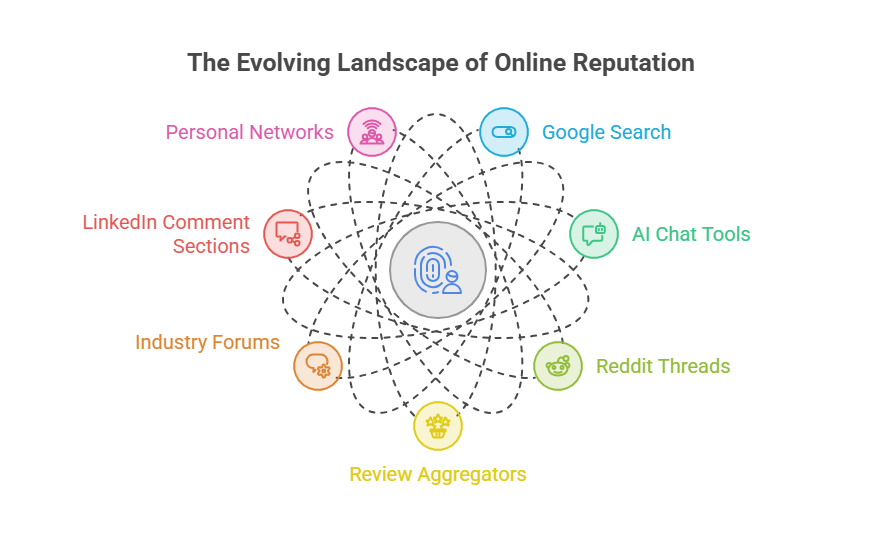
This is the biggest shift, and most business owners haven’t fully registered it. When someone wants to check you out today, before signing a contract, hiring you, or buying from you, they’re pulling information from several places at once:
- Google search, still, but often just as a starting point
- AI chat tools like ChatGPT, Gemini, and Claude, asked directly “is this company legit” or “tell me about [person]”
- Reddit threads, because people trust anonymous strangers more than branded content
- Review aggregators, industry forums, and LinkedIn comment sections
- Their own network, texting a friend to ask “have you heard of these guys”
Suppressing one bad article on page three of Google does nothing if an AI assistant is summarizing a negative Reddit thread as the top answer to “is [company] trustworthy.” That’s a completely different suppression problem, one that most legacy ORM agencies were never built to solve.
Pain Point #2: AI Models Are Now Part of the Verdict
This deserves its own section because it’s the single most disruptive change in the space. Large language models don’t rank pages, they synthesize an answer. When a prospective client asks an AI tool about your business, that model is pulling from training data, live search, and whatever content has enough authority and repetition to look reliable.
This has given rise to an entire new discipline: Answer Engine Optimization, or AEO. It’s not about ranking for keywords anymore. It’s about making sure that when an AI is asked to summarize who you are, it has enough consistent, credible, well-structured content to draw a fair and accurate picture, instead of latching onto the loudest complaint it can find.
Old-school ORM tactics (thin content farms, keyword-stuffed press releases, obviously templated bios) don’t just fail to help here. They can actively hurt, because AI models are increasingly good at recognizing low-effort, non-authoritative content and discounting it.
Pain Point #3: Removal Is Harder, and Suppression Alone Isn’t Enough
Getting content actually taken down was never easy, but platforms have tightened their policies even further. Google’s own removal criteria are narrower than most people assume. Defamation claims require real legal groundwork, not a form letter. Mugshot sites have gotten more sophisticated at re-publishing content the moment it’s removed elsewhere, sometimes under a new domain within days.
That means the old fallback (when you can’t remove it, just suppress it) has to work harder than it used to, because the negative content itself is more resilient, and it’s competing across more channels than a simple search results page.
The agencies still promising “guaranteed removal in 30 days” for a flat fee are mostly selling something they can’t consistently deliver. Real removal work is legal, procedural, and slow. Anyone skipping that process and going straight to mass content publishing is treating the symptom, not the cause.
Pain Point #4: Crisis Timelines Have Collapsed
A negative story used to take days to spread. Now it can circulate across five platforms in 5 minutes, get picked up by an aggregator overnight, and show up in an AI summary by the following morning. The businesses that come out of a reputation crisis intact are the ones that respond within hours, not days, with a coordinated plan across every channel where the story is live, not just the one where it started.
Reactive, once-a-quarter reputation check-ins don’t hold up against that speed. Reputation work in 2026 has to be monitored continuously, with a response plan ready before it’s needed, not built from scratch after the damage is already spreading.
Pain Point #5: Authenticity Detection Has Gotten Good
Fake reviews, bot-generated praise, and templated “client testimonials” used to slide by. Review platforms, search engines, and even casual readers are far better at spotting manufactured positivity now. A wave of suspiciously similar five-star reviews posted in the same week is more likely to trigger a platform investigation than to help you. Worse, it can damage trust with the exact audience you’re trying to win over.
What replaced it is real engagement: responding to reviews with specificity and consistency, building content that reflects an actual person or actual expertise, and letting genuine positive experiences accumulate naturally instead of manufacturing them. It’s slower. It’s also the only version that holds up under scrutiny.
So What Does Reputation Management Actually Look Like Now?
Put together, the shift looks like this:
From single-channel to multi-channel. Google is one input among several. Reddit, review platforms, AI answer engines, and social conversation all need attention.
From keyword SEO to AEO plus SEO. Ranking for search terms still matters, but so does being the source an AI model trusts enough to cite or summarize accurately.
From one-time cleanup to continuous management. Reputation isn’t a project with an end date. It’s an ongoing asset that needs monitoring and maintenance the same way security or finances do.
From volume to credibility. Publishing more content isn’t the win condition anymore. Publishing content that reads as genuinely authoritative, specific, and human is what actually moves the needle, with both search engines and AI systems.
From reactive to proactive. Waiting for a crisis to build a response plan is a losing position. The businesses handling this well have monitoring and a playbook in place before anything goes wrong.
Why This Requires the Right Partner, Not Just the Right Tools
None of this is a software problem you can solve with a dashboard subscription. It takes people who understand search behavior, AI content evaluation, legal removal processes, crisis response, and long-form content strategy, working together as one coordinated effort instead of four disconnected vendors.
This is exactly where ReputaForge has built its approach for 2026. Rather than offering a single narrow service, ReputaForge combines negative content removal, strategic search suppression, AI-era authority content, mugshot removal, review management, and crisis response under one roof, tailored to how reputations are actually assessed today, not how they were assessed five years ago.
For businesses and individuals across the US, Canada, and Australia, that means a reputation strategy built for the world as it actually works right now: one where Google is a starting point, AI models are quietly forming opinions in the background, and the difference between a managed reputation and an ignored one can be the difference between winning the next client or losing them before the first phone call.
If your current approach still treats reputation management as a Google-only game, it’s worth a conversation. ReputaForge can show you exactly where the gaps are, and what a modern, multi-channel strategy would look like for your specific situation.