In 2010, I could tell you where almost every visitor to a client’s website came from without opening a report: Google. Across the 20-plus business projects I worked on between 2010 and 2012, more than 90% of visits came from Google. Social media, mostly Facebook and Orkut, added under 2-3%.
That time is gone, and the confident claims about what replaced it are everywhere: “SEO is dead,” “AI will take your job,” “organic reach is over,” “you need hundreds of backlinks.” Some of these are half true, some are outdated, and some were never true. This guide sorts them out using what I have watched last, collapse, and quietly fade since 2010, and you can check every important claim yourself at Google Search Central.
The short answer
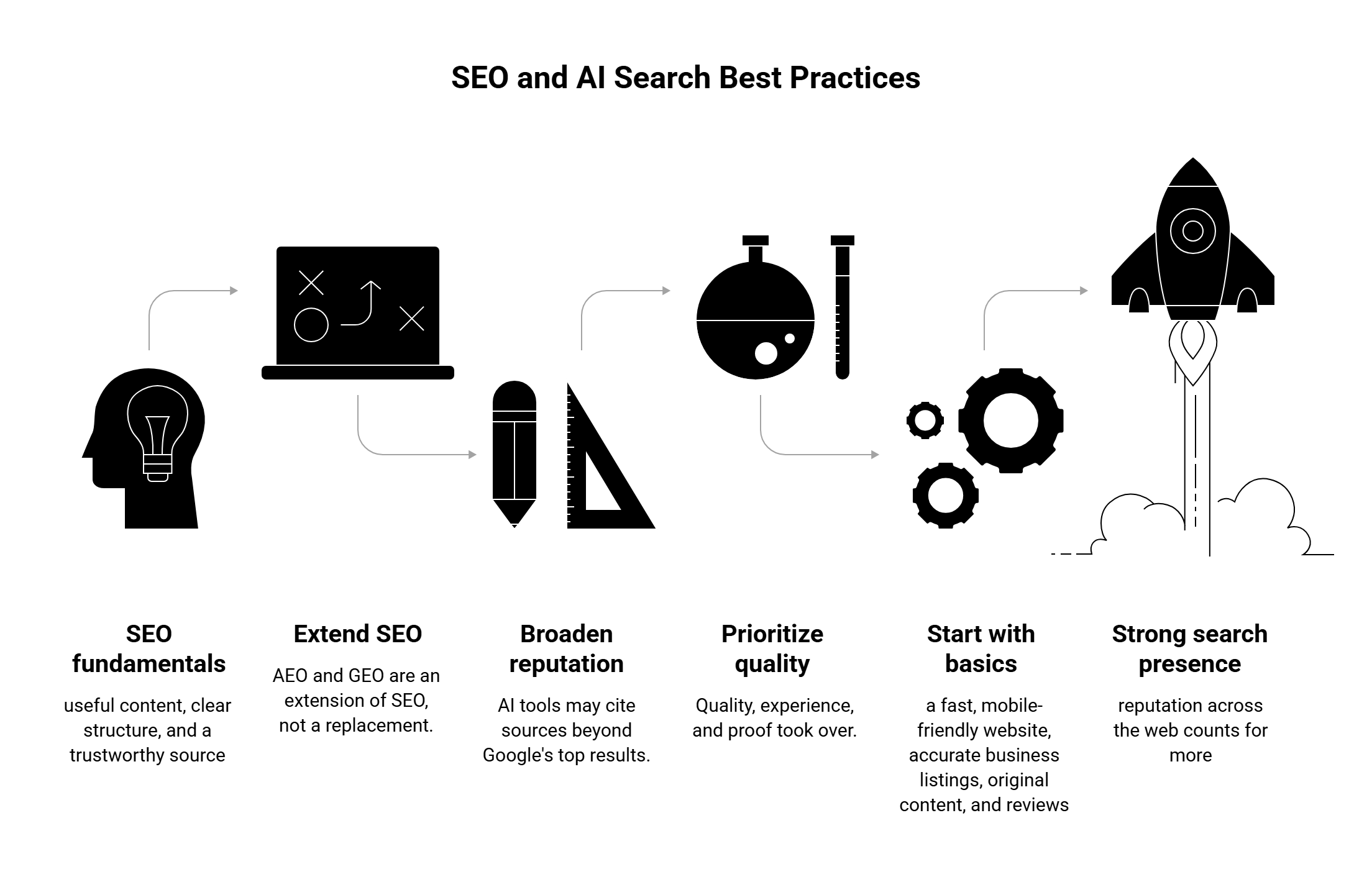
- SEO is not dead. Google still sends enormous traffic, and AI answer features draw on the same fundamentals: useful content, clear structure, and a trustworthy source.
- AEO and GEO (optimizing for AI answers) are an extension of SEO, not a replacement. Google says the same best practices apply to its AI features. What does change is that AI tools may cite sources beyond Google’s top results, so your reputation across the web counts for more.
- Quantity of links and low-quality content stopped working since 2011-2012 with every new search engine algorithm update. Quality, experience, and proof took over.
- Start with the basics, in this order: a fast, mobile-friendly website, accurate business listings, original content that shows first-hand experience, and reviews from real customers.
How search changed since 2010
2010: When Quantity Beat Quality
Earlier, SEO was simple enough that almost anyone could do it. The main activities were directory submissions, social bookmarking, article submissions, and forum posting. There was nothing to check content and backlinks’ quality: the same article could be posted a hundred times, and a hundred sites could share one IP address. What counted was the number of backlinks, plus metrics such as Alexa rank and PageRank. [I nearly left the field then, because a profession with no skill to build and no reward for experience did not seem worth staying in.]
Both of those metrics have since disappeared. Google removed the public PageRank toolbar in 2016, and Amazon shut down Alexa’s website rankings in 2022. Chasing a score that someone else controls is a risky habit. Google introduced regular search algorithm updates to prioritize the websites/webpages for ranking that are up to the mark on content and quality backlinks.
2011 and 2012: Quality Becomes the Rule
Google Panda arrived in February 2011 and targeted thin, low-value content, which hit content farms hard. Google Penguin followed in April 2012 and targeted manipulative link building. From then on, mass-produced content and spammy links stopped being a safe strategy. Matt Cutts, who then led Google’s webspam team, became the public face of that shift.
Google has kept raising the bar since: Hummingbird, page experience signals, the helpful content system (folded into Google’s core ranking in March 2024), and the added emphasis on E-E-A-T, which stands for experience, expertise, authoritativeness, and trust. Google added the first “E,” for experience, in December 2022. The pattern is consistent: each major update rewards real value and punishes shortcuts.
2015: Mobile User Experience Stops Being Optional
On April 21, 2015, Google began using mobile-friendliness as a ranking signal for mobile searches. Today Google predominantly indexes the mobile version of websites, so a site that works poorly on a phone is judged on that weaker version. For most businesses, the website is still where trust is built and leads are captured, so it has to work well on a small screen.
2022 onward: AI Changes How People Get Answers
ChatGPT’s public launch in late 2022 changed habits. Perplexity, Claude, Grok, and Google’s own AI Overviews (launched in the US in May 2024) followed. Many people now prefer one complete answer over ten links to compare. That is why visibility inside AI answers has become a real goal, and it is the reason the myths below deserve a closer look.
Seven Marketing Myths Worth Dropping
Myth 1: “SEO is Dead”
This claim has been repeated for more than a decade, and every few years a new technology triggers it again. What actually happens is that tactics expire while the goal stays the same: being the most useful, trustworthy result for a real question. Google still describes its AI features as built on its core ranking systems, and its guidance says there is no special extra optimization required to appear in them beyond good SEO fundamentals.
What has changed is the page itself. Search results now include AI summaries, maps, videos, and forums, so a plain ten-link result is rarer. That means more places to be found, as well as more places to be skipped.
Myth 2: “AEO is a Completely Different Discipline” (or “AEO is Exactly The Same as SEO”)
Both versions of this claim are too neat. The foundation is shared: clear headings, direct answers, accurate facts, and a source worth citing. Where they differ is in the sources AI tools pull from. Different assistants draw on different search indexes and on a wide mix of sites, forums, reviews, and news coverage. So a business that is mentioned accurately in several trusted places has a better chance of being cited than one that only publishes on its own website.
In practice: write pages that answer a question in the first few lines, back claims with named sources, and make sure your business details are consistent across your website, listings, and profiles.
Myth 3: “You Need as Many Backlinks as Possible”
This was close to true in 2010, which is why the belief refuses to die. Today, a handful of links from relevant, respected sites does more than hundreds from directories or link farms, and Google’s spam policies explicitly cover link schemes. Press releases are a good example of a tactic that looks productive and usually is not: they are useful for announcing real news, but the links they create rarely pass meaningful ranking value.
Links worth earning come from original research, useful tools, expert quotes, and content other writers actually want to cite.
Myth 4: “AI-Generated Content Can’t Rank”
Google’s published position is more nuanced than the myth. It does not penalize content simply because AI helped write it. It does penalize content produced mainly to manipulate rankings, including mass-produced pages that add no value, under its scaled content abuse policy.
The practical problem with fully AI-built pages is different: AI tools work from existing information, so they cannot supply your own experience, your clients’ real results, or your professional judgment. They can also state wrong information with complete confidence. Use AI to speed up research and first drafts, then add what only you know, and verify every claim before publishing.
Myth 5: “AI Will Take Your Marketing Job”
AI is taking over tasks, such as first drafts, reporting, and keyword grouping. It is much weaker at judgment: knowing which channel suits a client, spotting a claim that will not survive scrutiny, or noticing that a dashboard is measuring the wrong thing. Marketers who combine solid fundamentals with good use of AI tools are the ones gaining ground, so the safer move is to build the skills AI lacks.
Myth 6: “Organic Reach is Gone”
Organic reach on social platforms has fallen for many brand pages, and relying on it alone is risky. But “gone” overstates it. Search, video, podcasts, email lists, and community presence all still bring in visitors without paying per click. The better question is which owned channels you control, because an audience on your own website and email list cannot be switched off by an algorithm change.
Myth 7: “Paid Ads Cost Too Much, so SEO is The Only Option”
Paid ads and SEO do different jobs. Ads rent attention: results start quickly and stop when the budget does. SEO builds an asset that compounds slowly but keeps working. For a new business that needs customers this quarter, a small paid budget plus steady SEO work is usually more realistic than choosing only one.
Where to Put Your Effort First
Most small businesses cannot do everything at once. This is the order I would follow, and why.
- A fast, mobile-friendly website with clear structure. Everything else depends on it. First step: open your site on a phone and complete your main action, whether that is booking, calling, or buying. Fix whatever slows you down.
- Accurate business listings. A complete Google Business Profile matters most for any business with a local audience, followed by industry and local directories. First step: make sure your name, address, phone number, and hours match everywhere.
- Original content that shows first-hand experience. This is where E-E-A-T becomes visible. First step: pick your five most common customer questions and answer each one on its own page, using real examples.
- Reviews from real customers. Reviews build trust with both people and search systems. First step: ask satisfied clients after each project, and reply to every review, including the negative ones.
- Proof of who you are. Team bios, case studies, credentials, and the types of clients you serve. First step: add a named author and a short bio to every article.
- Technical basics. Title tags, headings, image descriptions, an XML sitemap, a correct robots file, sensible internal links, and structured data where it fits. A marketer who reads HTML can catch problems a dashboard never flags. One caution: Google restricted FAQ rich results in 2023 to well-known government and health sites, so use FAQ markup for clarity, not for expected search-result perks.
- Quality backlinks and mentions. Earn them with original data, expert commentary, and useful resources. First step: publish one piece worth citing, then tell the writers who cover that topic.
- Video and audio. Short, useful videos and podcasts about your services now drive traffic and leads for many businesses. First step: record answers to those same five customer questions.
- Consistent social profiles. They support trust and discovery, but they are rarely the foundation. Keep them accurate and active without over-investing.
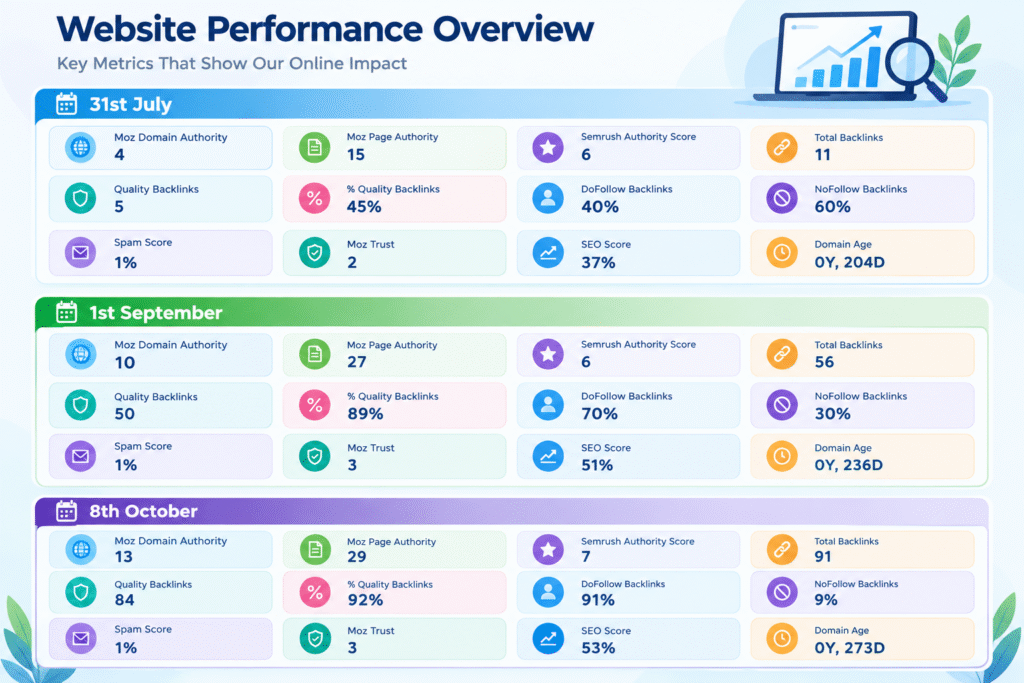
Refer to the screenshot below to see how this works for our clients at ReputaForge on a month-to-month basis.
Who to Learn From, And How to Read Them
Moz, Search Engine Land, HubSpot, Semrush, and Neil Patel have all published useful research and practical guidance over the years. Google’s own documentation, Google Search Central, and the Search Quality Rater Guidelines are the primary sources behind many of the claims in this guide.
Most of these publishers also sell software, so some articles lead to a product. They are still more dependable than blogs that present guesses as facts. Use them to learn, confirm important things with a second source, and notice when a recommendation is really a sales pitch.
Need Help Getting Found on Google And in AI Answers?
If you want a plan built on the fundamentals above, our team can audit your website, listings, reviews, and content and tell you what to fix first. Learn more about our AI search optimization service.
FAQs
Q1: Is SEO still worth it in 2026?
Answer: Yes. Search remains a major source of traffic, and Google states that its AI features rely on the same core systems and best practices.
Q2: What is the difference between SEO and AEO?
Answer: SEO aims to rank pages in search results. AEO, also called GEO, aims to get your content cited inside AI-generated answers. They share the same foundation of clear, accurate, trustworthy content, but AI tools may draw on a wider range of sources.
Q3: Can I use AI to write my blog posts?
Answer: Yes, with care. Google does not penalize content only because AI was involved, but it does penalize low-value content made at scale. Add your own experience, verify the facts, and have a person review everything.
Q4: How many backlinks do I need?
There is no magic number. A few links from relevant, trusted sites are worth more than many low-quality ones.
Q5: What should a small business fix first?
Answer: Your website’s mobile experience and your Google Business Profile, then original content and customer reviews.
Q6: How long does SEO take to show results?
Answer: It varies by competition and site history, but expect months rather than days. Track progress through rankings for your target questions, qualified enquiries, and mentions in AI answers.
Have any feedback or corrections for this guide? Contact us. We read every message.