

Updated on: 20th September 2026
Type “remove my mugshot from Google” into the Google search bar, and you’ll land on dozens of guides using that exact phrase without ever explaining what it means. Removal means a website takes your photo down. Suppression means pushing negative links beyond the positive assets in top results when someone searches your name on Google, whether or not the photo is still live somewhere else. They’re different problems with different fixes, and mixing them up is why a lot of people spend months on a strategy that was never going to work. This guide is built around suppression and has the approach that works.
Why Arrest Records Appear on Google in the First Place
Arrest bookings are treated as public information across most of the US, but “public” doesn’t mean the same thing in every state. Florida’s open-records law makes booking photos broadly accessible the moment someone’s arrested, which is a big part of why Florida names dominate mugshot sites. Other states are far more restrictive – Massachusetts locks arrest histories behind a separate access system, and a handful of states only open the record once there’s been a conviction. The National Conference of State Legislatures tracks this state-by-state, and it’s worth a look if you want to know exactly where your state falls.
Mugshot aggregator sites are built to exploit the open end of that spectrum. They pull booking data in bulk, publish a page for every name, and optimize each one for exact-match searches – your name plus your city, your name plus the charge. That’s a narrow, low-competition keyword a personal LinkedIn profile or portfolio site rarely competes for, which is exactly why the mugshot page often outranks everything else you’ve ever put online.
Removal vs. Suppression: Why This Guide Focuses on Suppression
A lot of guides cover these together, even a few of our blogs, and it causes real confusion. Removal means the site itself takes the content down. Suppression means the content may stay up somewhere, but it is pushed down from the top search results of Google and other search engines when someone searches your name, because stronger, more relevant results have taken its place.
Removal is worth attempting first, and it’s gotten easier than it used to be. For years, mugshot sites made money by charging people to take their own photo down — sometimes over a thousand dollars per arrest. States pushed back hard: at least fifteen states now ban charging a fee for mugshot removal, including Florida, Georgia, Illinois, Texas, Utah, Colorado, California, and several others, with most of these laws passed before 2020. The worst offenders have faced real consequences beyond fines — in 2018, California’s Attorney General filed criminal charges against the operators of Mugshots.com for extortion, money laundering, and identity theft, tied directly to their pay-for-removal scheme.
So if your state bans removal fees, it’s genuinely worth sending a written takedown request before spending money on anything else. But removal has a hard ceiling: it only works if the specific site cooperates, and plenty don’t, especially the ones hosted overseas or the ones that quietly republish content on a sister site after “removing” it from the original. That’s the gap suppression fills, and it’s what the rest of this guide is about.
What’s Actually at Stake
A mugshot ranking on page one of Google isn’t just uncomfortable — it affects real decisions people make about you. Employers who informally Google a candidate aren’t running the kind of formal background check covered by fair-hiring rules; they’re just looking, and what they see at 1st page shapes the call before an application ever gets a fair read. It’s worth knowing that the EEOC’s own guidance discourages employers from screening people out based on an arrest record alone, since an arrest isn’t proof of guilt — but that guidance governs formal hiring processes, not an informal search a hiring manager runs on their own. If your situation involves a specific charge type, our blog on what actually shows up for a domestic battery charge covers this employer-search gap in more detail.
Landlords screen the same way before signing a lease. Clients and lenders form a snap judgment before a call even happens. None of this means the record defines you — it means the search result is doing the talking until you give it something better to say.
The Suppression Playbook: What Actually Moves the Needle
This is the part that takes real work, and there’s no way around that. But it’s also the part that’s fully within your control, and it’s the same approach professional suppression campaigns run — just without a team executing it for you.
#1. Start by assessing every version of the search that surfaces the problem. That’s your full name alone, your name plus your city, your name plus your employer or industry, and your name plus the specific charge if that’s how it’s indexed. Each of these might return a slightly different set of results, and you need to know all of them before you can fix any of them.
#2. Audit what’s already ranking on page one of Google for these search terms. Some of what’s there you already control — an old LinkedIn, a dormant Twitter. Some of it’s neutral, like a directory listing. And some of it’s the negative content itself. This audit tells you exactly how much ground you need to make up, and where.
#3. Build a short list of platforms you fully control and that carry real authority with Google. LinkedIn, a personal website, an updated Google Business Profile (it appears in Knowledge Graph only) if you’re self-employed, relevant industry directories — these establish a baseline presence Google already trusts. The goal isn’t quantity; a handful of genuinely maintained profiles outperforms a pile of abandoned ones. Contact us if you want us to share a list of top websites that you can use to showcase your positive side and repair your online reputation.
#4. Know what to avoid, because a few common mistakes make the problem worse:
- Don’t link to the negative page from any of your assets – a backlink is a relevance signal, and you’d be handing it one.
- Don’t visit or share the negative result repeatedly; it can reinforce its association with your name in ways that work against you.
- Be careful with using discussion platforms like Reddit — you can’t control what someone else adds to a thread with your name on it.
- Skip any service promising “guaranteed removal in 24 hours” for a flat fee. Given how many of these sites have faced legal action for exactly that pitch, treat it as a red flag rather than a shortcut.
#5. Then build a monthly content calendar and stick to it for at least three to six months. This is where most self-directed attempts fall apart — not from a bad strategy, but from stopping after three weeks. Creste content like- bios, blog posts, social updates, a video or two, a detailed guide in your field – each piece should be genuinely useful to someone searching your name for a legitimate reason, not just keyword-stuffed filler. Content that’s actually worth reading is also the content people naturally link to, which earns you backlinks you didn’t have to ask for.
#6. Interlink your own assets the way any real personal brand would — your bio references your latest article, your article links back to your profile. Natural, not forced.
#7. Finally, track your target terms over time. Early movement often shows up within a few weeks, but durable, page-one change is a three-to-six-month process, sometimes longer if the negative content holder site itself has strong domain authority. There’s no way to guarantee a timeline, and anyone who promises one isn’t being straight with you.
Doing It Yourself vs. Bringing in Help
Everything above is genuinely doable without hiring anyone, and plenty of people have handled it on their own with consistency and patience. Where it gets harder is time and specialized skill: writing content that’s actually good enough to rank, understanding technical SEO well enough to know why one page outranks another, and keeping up a monthly cadence for half a year while also working a job.
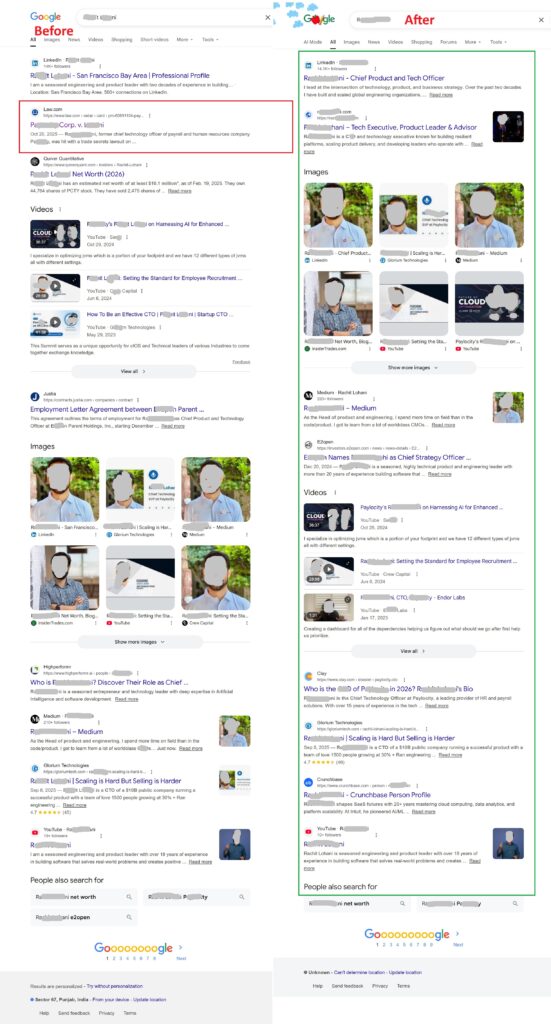
Professional help tends to make the most sense when the timeline is urgent — an upcoming job search or license review – when your name is a competitive search term, or when you’d simply rather hand the work to someone who does it daily. Our suppression process runs on the same fundamentals covered here, executed systematically and tracked against results; you can see how that’s played out on an actual case in our suppression case study.
If you’d rather talk through your specific situation than run the whole playbook solo, reach out for a free confidential assessment report and consultation — there’s no charge to talk through what’s realistic for your case.
Frequently Asked Questions
Q1: Can a mugshot be permanently removed from Google?
Answer: Not directly – Google doesn’t remove arrest records just because you ask, since they don’t violate its content policies. What works is suppression: building up stronger, more relevant content until the mugshot no longer ranks on the pages people actually check.
Q2: My charges were dropped or expunged — shouldn’t the mugshot disappear on its own?
Answer: Not automatically. Expungement seals the official record, but it doesn’t obligate a mugshot website to update or remove its listing unless your state’s law requires it. Checking whether your state bans removal fees is worth doing first — many mugshot sites are legally required to take it down for free if you ask in writing.
Q3: Is it legal for a site to charge me to remove my own mugshot?
Answer: It depends on your state. At least fifteen states now prohibit charging a fee for mugshot removal, and a few sites have faced serious legal consequences for the practice. Check your state’s law before paying anyone for removal.
Q4: How long does suppression realistically take?
Answer: Most campaigns show early movement within a few weeks and meaningful page-one change within three to six months, depending on how competitive your name is and how consistently the plan gets executed.
Q5: Can I do this myself, or do I need a professional?
Answer: You can, and the playbook above is the same one professionals use. The trade-off is time and skill rather than possibility — it takes consistent content creation and SEO know-how sustained over months.
Q6: Will Google remove it if I report it directly?
Answer: Only in narrow cases, like non-consensual imagery or content that violates specific policies. Arrest records don’t typically qualify, which is why suppression — not a takedown request to Google — is the practical path for most people.